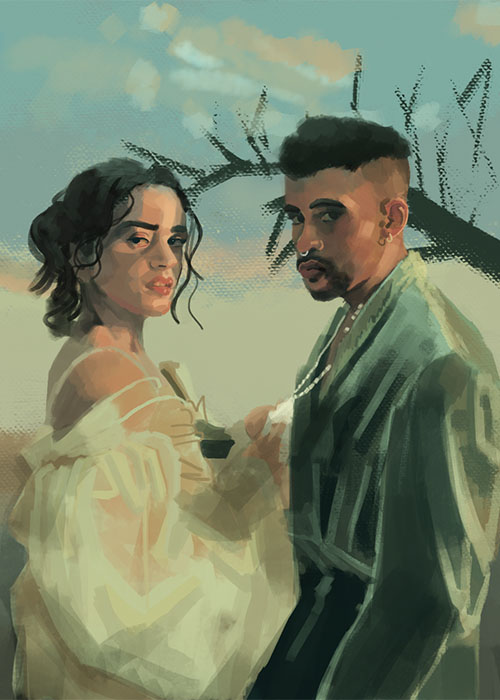
vWe initiated the pipeline with comprehensive look development in Cinema 4D, establishing the complex material nodes required to simulate the subtle imperfections, specular highlights, and subsurface light transport of antique porcelain. Simultaneously, the 3D animation phase focused on the physical choreography of the teacups and camera layouts, prioritizing graceful, cinematic framing that would best stage the upcoming artwork. Instead of applying the illustrations directly as diffuse textures in Redshift, we exported the raw UV coordinates alongside comprehensive AOV passes, including specular, reflection, depth, and custom mattes. Transitioning into After Effects, we leveraged the ft-UVPass workflow to inject the animated 2D illustrations into the rendered UV space, mathematically wrapping the flat artwork around the 3D geometry in post-production. This post-texturing technique allowed us to refine the 2D animation timing and narrative beats independently of the heavy 3D render times. Finally, the dense AOV layers were composited back over the freshly mapped illustrations, precisely reintroducing the physical lighting, glaze reflections, and depth of field to finalize the cohesive integration of traditional 2D storytelling within a photorealistic 3D environment.