00%

3D Animation

3D Animation

Stuff that British Stole S2 | Episode 2: Australia's Egyptian Mystery

Stuff that British Stole S2 | Episode 2: Australia's Egyptian Mystery

Stuff that British Stole S2 | Episode 2: Australia's Egyptian Mystery

/// Overview

/// Overview

For Episode 2 of the BBC/ABC series Stuff the British Stole, we crafted key animated sequences that follow the colonial path of an ancient Egyptian mummy from the pyramids to an Australian university, blending historical storytelling with a distinctive stylized aesthetic.

For Episode 2 of the BBC/ABC series Stuff the British Stole, we crafted key animated sequences that follow the colonial path of an ancient Egyptian mummy from the pyramids to an Australian university, blending historical storytelling with a distinctive stylized aesthetic.

// General Information
Role
Motion Design, 3D Animation
Duration
3 months
Software
After Effects, Cinema 4D, Octane Render
Credits
Studio: Lafinka.tv in collaboration with The Buraeau StudioCreative Director: Andrés Gomez Isaza and Keke Marc RobertsonThanks to: Alejandra Morales (creative producer), David Osorio (Lead technical and visual artist), Alejandra Tilano (Lead concept artist), Alejandro Londoño (Designer and illustrator), and all artists involved in the project.Client: BBC / Wildbear EntertainmentDirector: Patrick ShannonHost: Marc Fennell

/// The Challenge

/// The Challenge

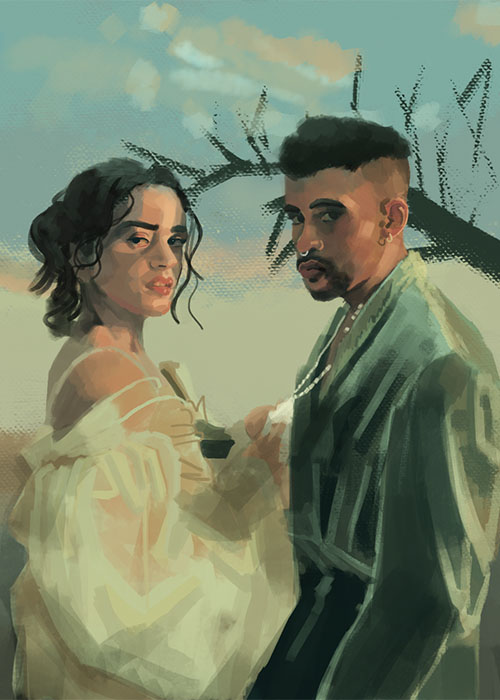
Delivering historically respectful yet visually compelling animation under tight broadcast timelines required precise translation of 2D Egyptian-inspired designs into believable 2.5D environments. Maintaining strict adherence to original Photoshop illustrations while enabling 3D camera movement, dramatic lighting contrasts inspired by pyramid interiors, and seamless integration of character and environment assets proved technically demanding.

/// The Solution

/// The Solution

We implemented a rigorous texture projection pipeline where every 3D asset was modeled and UV-mapped with absolute fidelity to the hand-illustrated designs from Photoshop. This allowed the scenes to retain a strong 2D graphic quality while gaining the spatial depth and cinematic lighting possibilities of 3D. Early styleframes helped define a dramatic, high-contrast look evoking ancient passages and colonial tension, which was successfully adapted into the final direction.

/// The Process

/// The Process

The workflow started with preproduction, early styleframe exploration, and animatic development, followed by asset modeling and scene setup in Cinema 4D. Photoshop illustrations were then projected onto simplified geometry using texture projection workflows, while Octane was used for lighting, atmosphere, and final rendering.